Every year, MediaTek updates its Dimensity lineup, and the 2025 version is the Dimensity 9500. It was announced in 2025 and brings some noticeable hardware changes. The chipset is built on TSMC’s 3nm process and uses an all-big-core CPU setup, along with a Mali-G1 Ultra GPU and the newer NPU 990 for AI-related tasks.
On paper, it’s clearly aimed at high-end Android phones, whether that’s for gaming, content creation, or just everyday performance. Here are five things worth knowing about the Dimensity 9500.
MediaTek Dimensity 9500: Specs That Matter
| CPU Architecture | 1× Arm C1-Ultra @4.21GHz + 3× C1-Premium @3.5GHz + 4× C1-Pro @2.7GHz (Octa-core) |
| GPU | Arm Mali-G1 Ultra MC12 |
| NPU | MediaTek NPU 990 |
| Imaging | MediaTek Imagiq 1190 |
| Connectivity | 5G |
CPU and Process Node
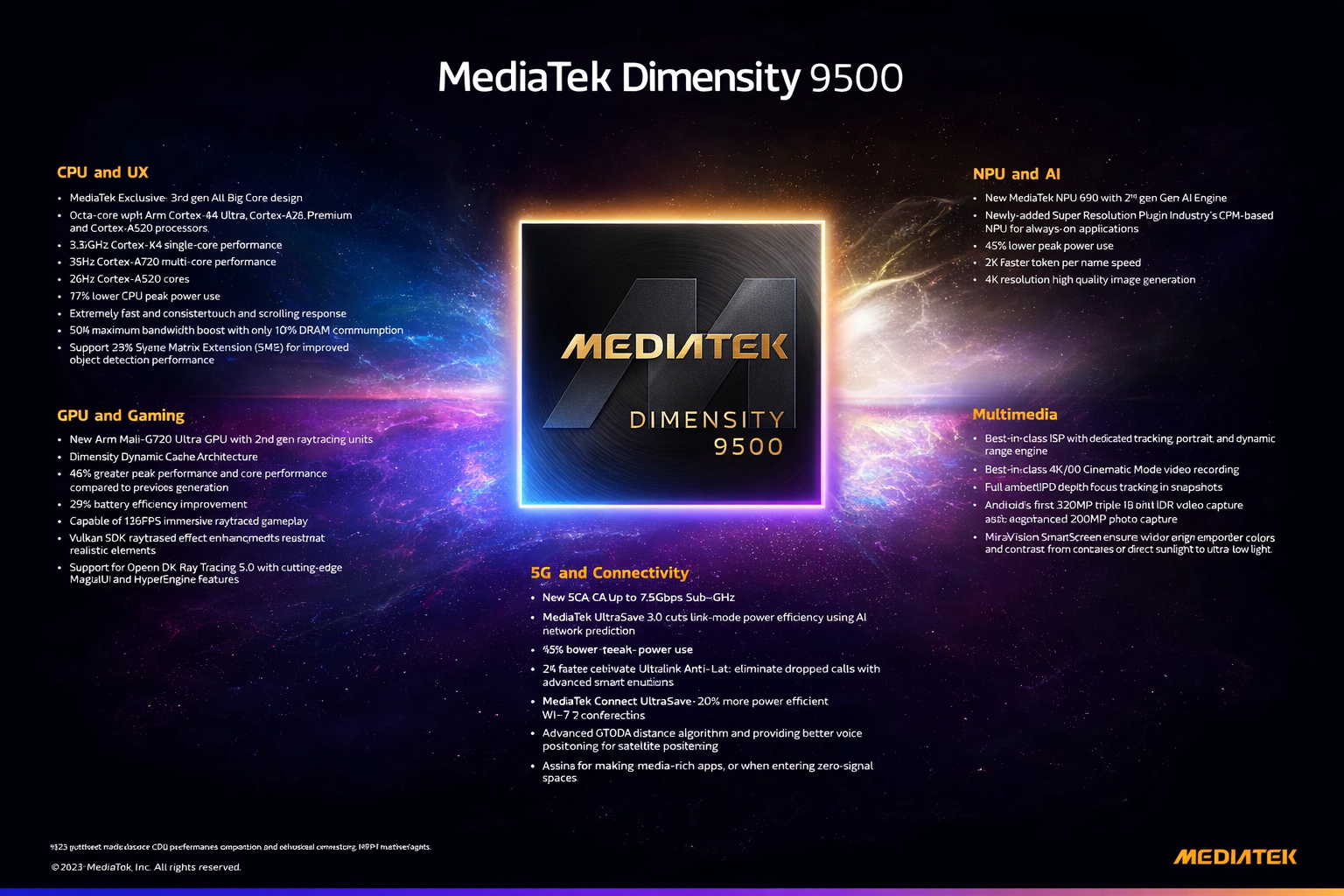
The Dimensity 9500 is the first chipset from MediaTek to use ARM’s new C1-series CPU cores, and it’s built on TSMC’s 3nm (N3P) process. It also continues MediaTek’s all big core approach, which means there are no smaller efficiency cores in the setup.
Instead, you get an octa-core CPU with one C1-Ultra core running at 4.21 GHz, three C1-Premium cores at 3.5 GHz, and four C1-Pro cores at 2.7 GHz. The idea here is to keep performance consistent across different tasks, rather than switching between high-power and low-power cores.
Another noticeable change is the increase in on-chipset cache. The L1 cache is now about 100% larger, and the L3 cache has also been increased by around 33% compared to the previous Dimensity flagship.
In simple terms, this helps reduce delays when the CPU needs data, which can make a difference in heavier tasks.
It also adds support for 4-lane UFS 4.1 storage, which hasn’t been seen on phones before, which makes it the world’s first. This mainly improves data transfer speeds and can help with things like loading large apps or AI models a bit faster.
GPU and Gaming
On the graphics side, the Dimensity 9500 uses the new Arm Mali-G1 Ultra MC12 GPU, which comes with a 12-core setup. It’s a step up from the previous generation, with MediaTek claiming around 33% better performance and improved efficiency as well.
For gaming, one of the more notable additions is support for ray tracing at up to 120 fps. That’s something that hasn’t really been seen on a smartphone chipset before, at least at this level. In practical terms, it should help with more detailed lighting and smoother gameplay in supported titles, though it will still depend on how well games are optimized.
Beyond the specs, there are a couple of software-related changes that stand out on the Dimensity 9500. It now supports the Vulkan ray tracing pipeline, which allows developers to add more realistic lighting and reflections in games that actually use it.
Dimensity 9500 also has support for newer versions of Unreal Engine 5, including features like improved lighting systems and more detailed environments.
Of course, how much this matters will depend on whether game developers take advantage of it. MediaTek has also updated its HyperEngine gaming features. One part of this is frame rate upscaling, where some games running at 60 FPS can be pushed closer to 120 FPS.
AI Engine and Camera Specs
AI is one of the bigger upgrades on the Dimensity 9500. It uses the new NPU 990, which is roughly twice as powerful as the previous version and is mainly used for things like text generation, image editing, and video call enhancements, all running directly on the device.
The new NPU can also process larger inputs and more complex AI tasks locally. Apart from faster photo edits, real-time translation, and smoother voice assistant responses, On-device AI is also more private and secure.
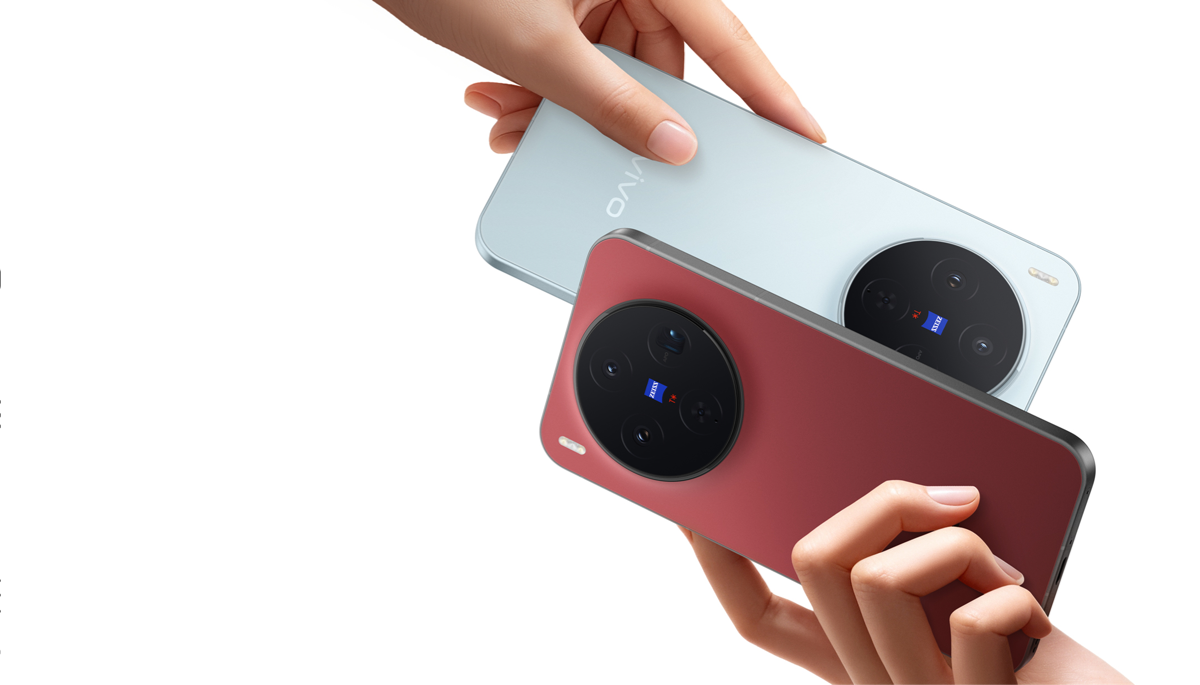
On the camera side, Dimensity 9500’s new Imagiq 1190 ISP brings some solid improvements to camera performance. It supports very high-resolution sensors (up to 320MP) and allows features like 4K video recording at 120FPS with stabilization. There’s also a 4K60 cinematic mode for more polished-looking videos.
For displays, the chipset includes updates to improve color handling and brightness control. It can go very dim for night use and still stay clear outdoors in bright sunlight while also supporting high-resolution and high-refresh-rate screens.
Connectivity
On the connectivity side, the Dimensity 9500 brings an updated 5G modem with support for high speeds and better global compatibility. AI also finds use here in managing network traffic and reducing latency.
For Wi-Fi, it supports Wi-Fi 7 with faster speeds and more stable connections, especially when using multiple bands at once. There are also some power-saving improvements while streaming or downloading large files.
Other features include improved GPS accuracy with faster location locking and Bluetooth upgrades for better range, lower latency, and more stable connections with wireless devices.
Did MediaTek Finally Make it?
The MediaTek Dimensity 9500 looks like a well-rounded flagship chipset from MediaTek. Based on early benchmarks and features, it’s clearly designed to compete closely with other top-end processors in areas like performance, gaming, AI, and camera capabilities.
Phones like the OPPO Find X9 Pro and Vivo X300 Pro are already using it, and for now, it is holding up well in real-world use.
MediaTek Dimensity 9500: FAQs
Is the MediaTek Dimensity 9500 better than the Snapdragon 8 Elite Gen 5?
In CPU single-core, GPU ray tracing, and power efficiency, the Dimensity 9500 is competitive or ahead. Snapdragon leads in raw multi-core and 5G peak speeds.
What phones use the MediaTek Dimensity 9500?
The OPPO Find X9 series and Vivo X300/X300 Pro are among the first devices powered by the Dimensity 9500.
What is the Dimensity 9500 AnTuTu score?
The Dimensity 9500 crossed the 4 million score on AnTuTu v11.