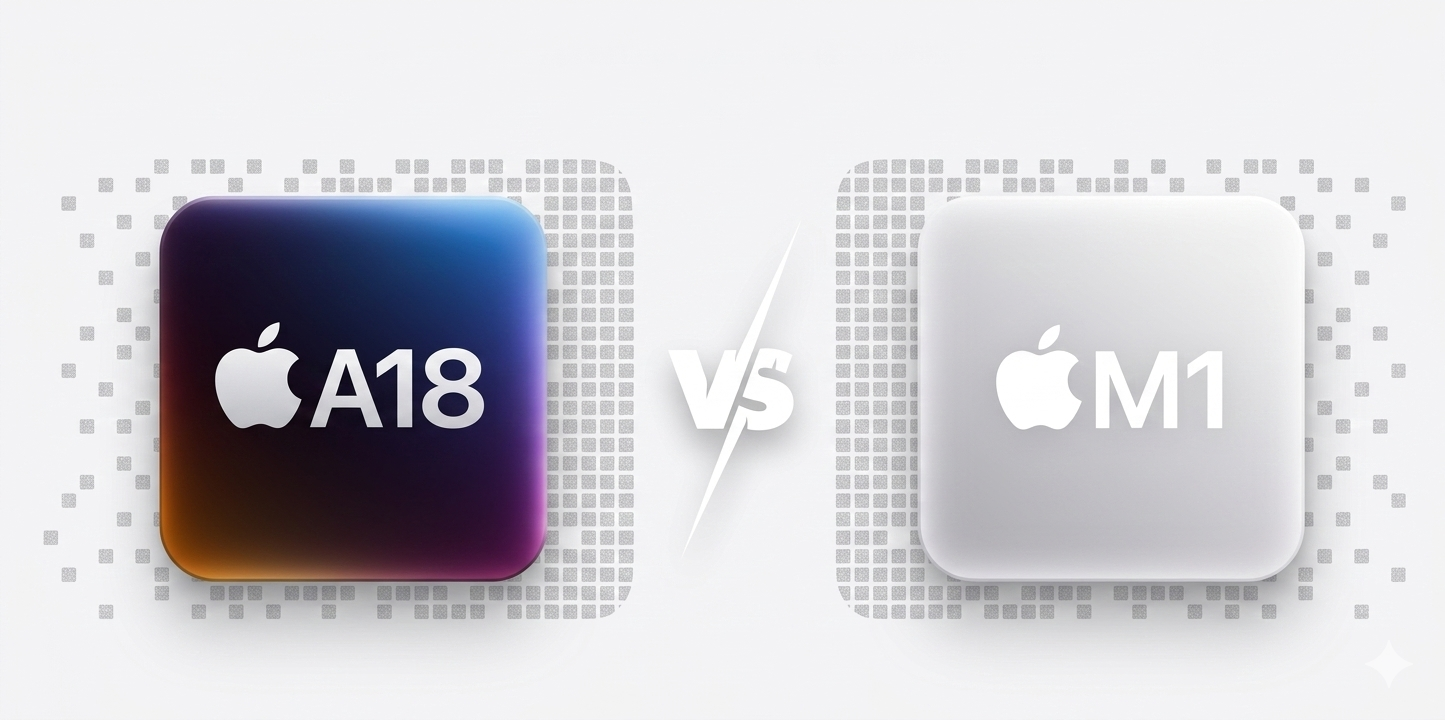
Apple has done something unexpected with its latest launch. The brand-new MacBook Neo is priced at just INR 69,900. And it does not feature an M-series chip like its predecessors. Instead, it runs on the A18 Pro chip, the same chip that powers the iPhone 16 Pro. For millions still using the trusty M1 MacBook Air from 2020, the question arises. Should I upgrade from an Apple M1? Let’s break it down and see what this new chipset really brings to the table.
Also See: How to Setup a Custom Ringtone on Apple iPhones
Apple A18 Pro vs Apple M1: Main Differences
| Specs | A18 Pro | M1 |
| Process Node | 3nm (TSMC) | 5NM (TSMC) |
| CPU Cores | 6 Core (2 performance + 4 efficiency) | 8 core (4 performance + 4 efficiency) |
| GPU Cores | 5 Core | 7/8 Core |
| TOPS | Up to 35 TOPS | Around 11 TOPS |
| Ray Tracing | Hardware Support | Not Supported |
| Transistors | ~20 billion | ~16 billion |
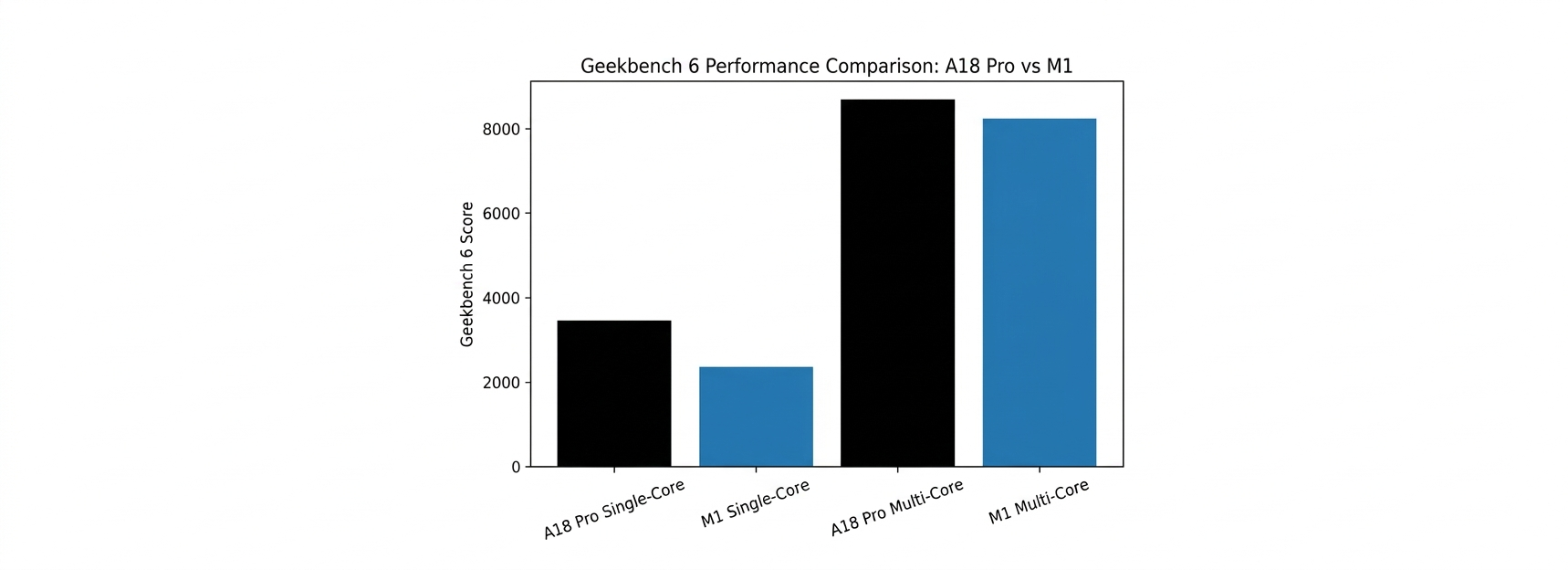
| Geekbench 6 Single-Core | 3400 – 3500 | 2300 – 2400 |
| Geekbench 6 Multi-Core | 8500 – 8900 | 8000 – 8500 |
| Price | INR 69,900 | INR 1,19,900 |
Apple A18 Pro
The A18 Pro chip is built on TSMC’s advanced 3nm process and packs around 20 billion transistors. It comes with a 6-core CPU (2 performance cores and 4 efficiency cores) and a 5-core GPU that even supports hardware-accelerated ray tracing. You also get a 16-core Neural Engine and 60 GB/s of memory bandwidth.
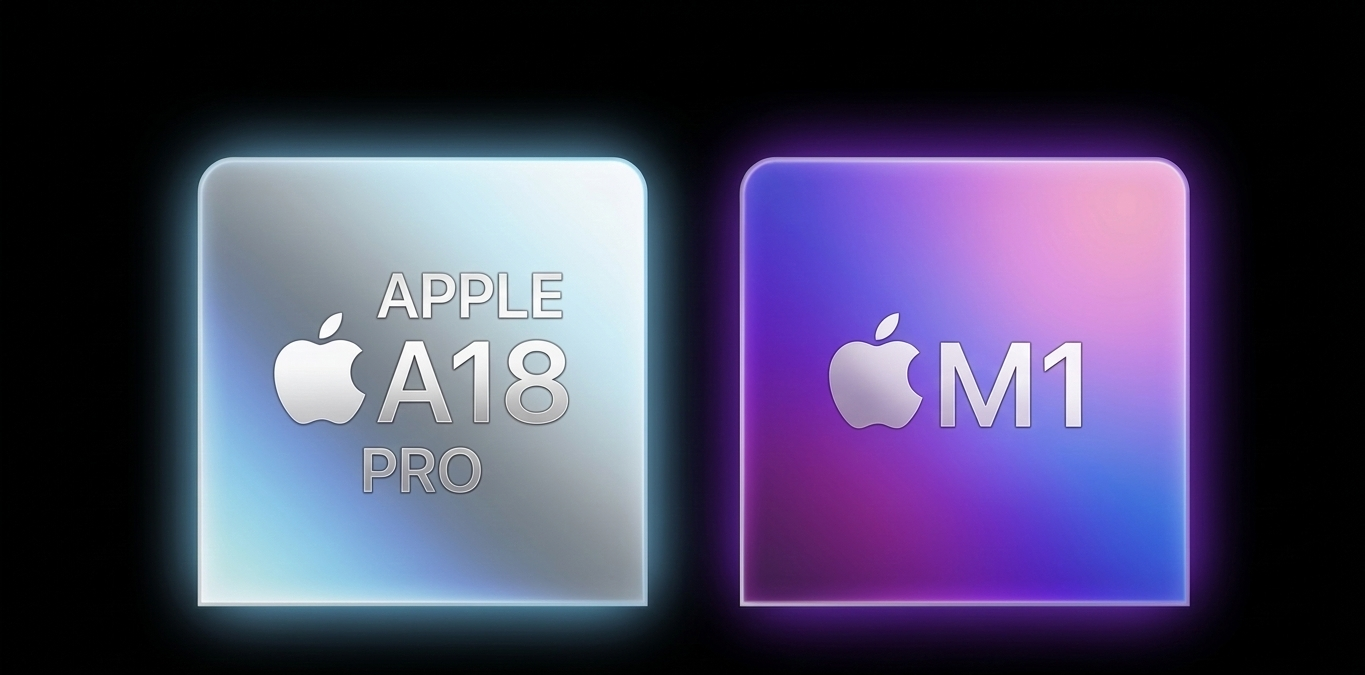
What’s really impressive is the Neural Engine. It can handle up to 35 trillion operations per second, which is roughly twice the machine learning power of the A16 Bionic. So when it comes to AI-driven tasks, the A18 Pro performance is clearly built to deliver serious performance.
Apple M1
On the other hand, the Apple M1 chip is an old chip. It launched in late 2020 and came with an 8-core CPU (4 performance cores and 4 efficiency cores), a 7/8-core GPU, and a 16-core Neural Engine. Thanks to Apple’s unified memory architecture, even the base 8GB MacBook Air felt fast and powerful in everyday use.
More importantly, the M1 proved that Apple Silicon was not just a trick. Even after five years, it still performs surprisingly well for most tasks.
Also See: UFS 5.0 Is Coming: How it will Revolutionize Smartphone Performance
Performance & Banchmarks
This is where things get interesting. In Geekbench 6 tests, the A18 Pro scores around 3,400 – 3,500 in single-core and 8,500 – 8,900 in multi-core. The original M1 usually scores about 2,300–2,400 in single-core, which means the A18 Pro chip is roughly 40–50% faster in single-threaded tasks.
In everyday use, like browsing the web, opening apps, or doing light multitasking, the A18 Pro can feel noticeably quicker. Apple also says the MacBook Neo can be up to 50% faster for daily tasks compared to Intel Core Ultra 5 PCs, 3X faster for on-device AI tasks, and 2X faster for photo editing.
And, when it comes to long, heavy workloads like video rendering or compiling code, the A18 Pro either competes closely with the M1 or sometimes falls slightly behind. This mainly comes down to thermal limits. It is a good reminder that laptop chips and phone chips, even from Apple, are designed with different priorities.
GPU & Creative Work
The Apple A18 Pro comes with a powerful GPU that even supports hardware ray tracing. In many situations, it performs quite close to the M1’s 7/8-core GPU. For things like casual gaming, video editing, binge watching, and smooth UI performance, it handles both 1080p and 4K content without any issues.

For most everyday users, the difference between the two GPUs is small. In real-world use, you probably would not notice a big performance gap.
Also See: Has Apple Finally Given Up on Apple Intelligence?
AI and Neural Engine
AI is one area where the A18 Pro really stands out. It comes with a 16-core Neural Engine that can handle up to 35 trillion operations per second (TOPS). This means on-device AI tasks can run much faster, even up to 3× quicker than some Intel-based systems.
Apple Intelligence features such as predictive typing, smart photo editing, and app suggestions are smoother and quicker than on the M1, which was developed before AI workloads became central to Apple devices.
The M1 also has a strong neural engine, but it was designed at a time when AI features were not as central to Apple devices as they are today. So naturally, the A18 Pro feels more optimized for modern AI tasks.
Should M1 MacBook Users Upgrade?
For students, casual users, or anyone looking for a secondary device, the MacBook Neo with the A18 Pro offers a great macOS experience at INR 69,900(or INR 59,900 with education pricing). If you are wondering. So, should you upgrade from an Apple M1? Well, why not?
However, if you are a power user like a video editor or software developer who pushes the M1 with heavy workloads, then it might be better to wait for a MacBook with an M3 or M4 chip for higher performance. The A18 Pro is not really meant to replace the more powerful MacBook Pro models designed for demanding tasks.
Final Thoughts
The A18 Pro in the MacBook Neo is definitely impressive. It is faster than the M1 in single-core tasks, performs really well in AI features, and comes in one of Apple’s most affordable MacBooks yet.
If your M1 MacBook is still running smoothly, then there is no need to upgrade right now. But for students, first-time Mac buyers, or people whose M1 devices is starting to feel old, the MacBook Neo could be a great option. It is budget-friendly and delivers strong performance.