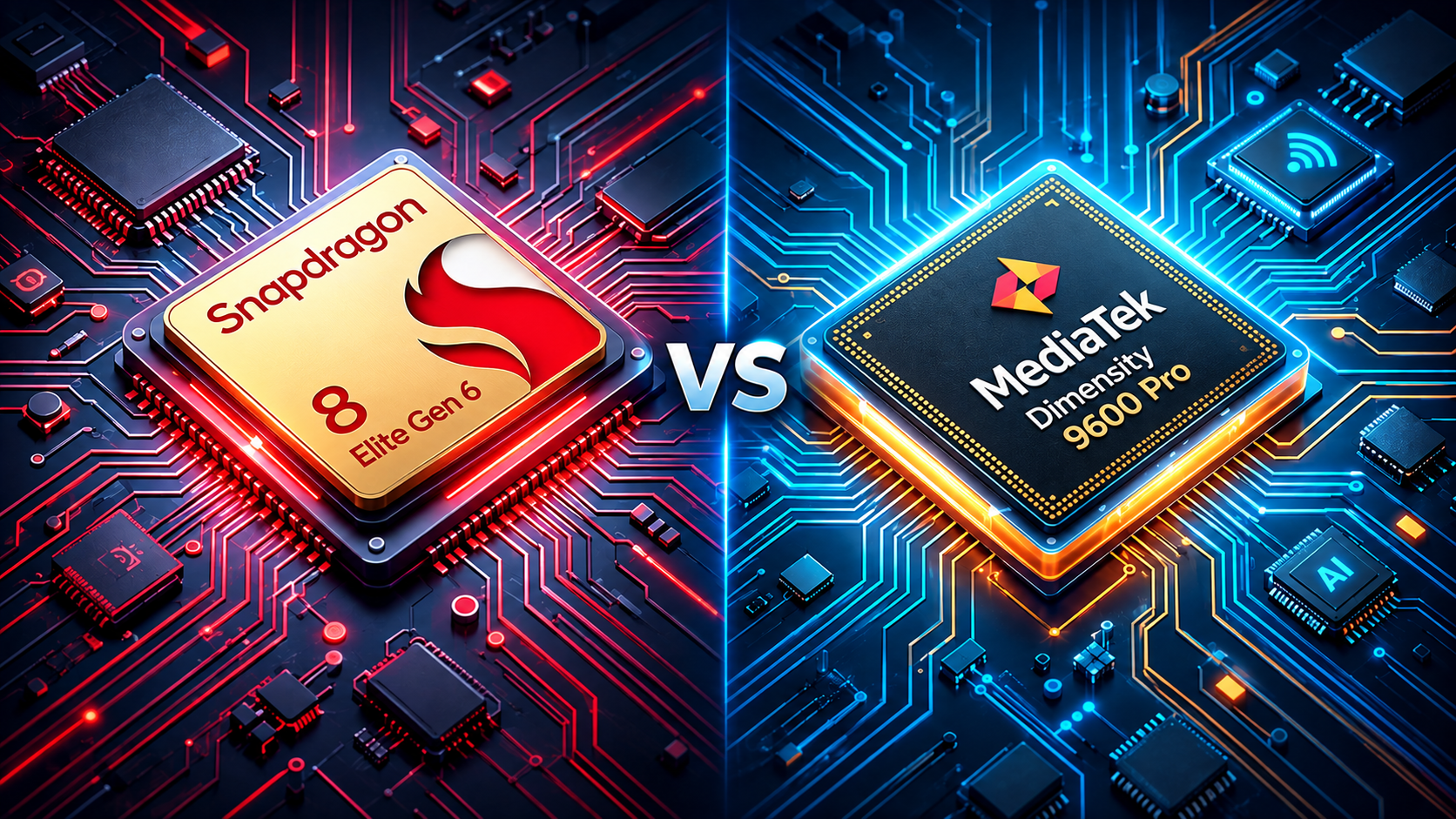
MediaTek announced the Dimensity 9600 Pro on September 15, 2026, and Qualcomm announced the Snapdragon 8 Elite Extreme Gen 6 and Snapdragon 8 Elite Gen 6 on September 22, 2026. Both are built on a 2nm process and target the same flagship Android market.
Both platforms have appeared in Geekbench 7 ahead of phones shipping later this year. Here is how they actually stack up.
Quick Specs: Side by Side
| Feature | Snapdragon 8 Elite Gen 6 Specifications | MediaTek Dimensity 9600 Pro Specifications |
| Process Node | TSMC 2nm | TSMC 2nm (N2P) |
| CPU Architecture | Custom-built Qualcomm Oryon CPU with two prime cores clocked up to 5GHz | ARM all‑big‑core, 2+3+3 (2 C2‑Ultra + 3 C2‑Pro + 3 C2‑Pro) |
| Prime Core Speed | Up to 5.0GHz (2 cores) | Up to 4.55GHz (2 C2‑Ultra) |
| GPU | Qualcomm Adreno GPU | Arm Mali-G2 Ultra NX GPU |
| Memory | LPDDR5X / LPDDR6 | LPDDR5X / LPDDR6 |
| Storage | UFS 5.0 | UFS 5.0 |
| Video Capture | Up to 8K30, 4K120 slow‑mo (standard Gen 6); Extreme variant adds 8K60, 4K240 | Up to 8K60, 4K240 slow‑mo, 4K120 with EIS |
| Expected Phones | Flagships from Xiaomi, OnePlus, Motorola, others | Flagships from Vivo, Oppo, others |
Snapdragon 8 Elite Gen 6 vs Dimensity 9600 Pro: CPU
This is where the gap between the two chips is most visible. The Snapdragon 8 Elite Gen 6 uses Qualcomm’s custom Oryon architecture in a 2+6 layout, with two prime cores at up to 5.0GHz and six performance cores at up to 4.0GHz.
The Dimensity 9600 Pro takes a different path: an all‑big‑core ARM design with two C2‑Ultra cores at 4.55GHz, three C2‑Pro cores at 4.35GHz, and three C2‑Pro cores at 3.10GHz in a 2+3+3 configuration.
As of now, Snapdragon 8 Elite Gen 6 vs Dimensity 9600 Pro performance requires independent testing.
CPU winner: Snapdragon 8 Elite Gen 6 (on paper, as early benchmarks favor Qualcomm’s Oryon design).
Snapdragon 8 Elite Gen 6 vs Dimensity 9600 Pro: GPU
The Snapdragon 8 Elite Gen 6 uses a reengineered Adreno GPU with hardware‑accelerated ray tracing and Vulkan 1.4 support. The full Neural Fusion feature set (with dedicated matrix cores) is reserved for the Extreme variant, but the standard Gen 6 still benefits from the new sliced Adreno architecture and improved memory handling.
The Dimensity 9600 Pro uses the Arm Mali‑G2‑Ultra NX GPU with hardware‑accelerated ray tracing across all cores and MediaTek’s StarSpeed Engine for frame generation and super‑resolution. The Mali‑G2‑Ultra NX has more cores, but the Adreno architecture processes AI graphics workloads more efficiently per core.
GPU winner: Dimensity 9600 Pro on raw ray‑tracing core count, Snapdragon 8 Elite Gen 6 on efficiency and AI graphics (with Extreme pulling further ahead).
Snapdragon 8 Elite Gen 6 vs Dimensity 9600 Pro: Gaming
For gaming, the Extreme model adds Neural Fusion and matrix cores, but sustained gaming superiority requires phone-level testing. Qualcomm also has more established relationships with game developers for Adreno‑optimized titles.

MediaTek’s Neural Graphics Architecture combines GPU and NPU resources for graphics features such as super resolution and ray-traced rendering. And the Mali-G2 Ultra NX supports hardware-accelerated ray-traced gaming. Phones with the Dimensity 9600 Pro also tend to carry strong cooling systems from brands like Vivo, which can close the sustained performance gap in real‑world gaming.
Note that real‑world gaming comparisons require phone‑level testing. Raw chip benchmarks do not account for thermal management, which varies significantly between OEMs.
Gaming winner: too early for a definitive real‑world verdict.
Read More: https://sparknherd.com/how-to/increase-your-threads-impressions/
Other Differences Worth Knowing
Storage: Both chips support UFS 5.0. There is no UFS 4.0 vs UFS 5.0 gap here.
Availability: Qualcomm chips go into almost every major Android OEM (Samsung, Xiaomi, OnePlus, Motorola, etc.). MediaTek’s Dimensity 9600 Pro is likely to appear in a smaller pool of brands, primarily Vivo and Oppo, at launch.
Efficiency: Both chips are on TSMC 2nm. MediaTek reports major efficiency gains for the Dimensity 9600 Pro, including a 61% reduction in multi‑core power versus the prior generation, even if absolute peak scores trail Snapdragon in some tests.
Video: The standard Snapdragon 8 Elite Gen 6 supports up to 8K30 and 4K120 slow‑mo, and the Extreme variant raises this to 8K60 and 4K240. Dimensity 9600 Pro supports up to 8K60 and 4K240 slow‑mo out of the box.
Conclusion: Who Wins?
On paper and in early Snapdragon 8 Elite Gen 6 vs Dimensity 9600 Pro benchmarks, the Snapdragon 8 Elite Gen 6 leads or matches the Dimensity 9600 Pro, particularly on CPU speed and AI/gaming architecture. The Dimensity 9600 Pro is not far behind, and its all‑big‑core design shows solid efficiency gains.
In practice, the phone you buy matters as much as the chip inside it; cooling, software, and build quality will shape the real‑world gap more than spec sheets will. Phone‑level reviews will tell the full story once devices ship later this year.
FAQs
Which is faster, Snapdragon 8 Elite Gen 6 or Dimensity 9600 Pro?
The Snapdragon 8 Elite Gen 6 leads the Dimensity 9600 Pro on paper, but real-world testing will show the real performance once the phones are out.
Is MediaTek Dimensity 9600 Pro better for gaming?
Not definitively. The Snapdragon 8 Elite Gen 6’s Adreno architecture excels in efficiency and AI gaming, while the Dimensity 9600 Pro’s 12‑core Mali‑G2‑Ultra NX is competitive on raw ray‑tracing muscle. Cooling and OEM tuning determine the real winner.
Snapdragon 8 Elite Gen 6 vs Dimensity 9600 Pro: which has the better CPU?
The Snapdragon 8 Elite Gen 6. Its custom Oryon cores at up to 5.0GHz (2 Prime + 6 Performance) outperform the Dimensity 9600 Pro’s ARM‑based C2‑Ultra cores at 4.55GHz in early benchmark runs and architectural design.